
Living Ontology Engine
An ontology that grows, adapts and reorganizes itself.
Traditional knowledge graphs are static and quickly become stale. MetraOS runs a Living Ontology that self-constructs, self-expands and reshapes itself as the world changes — powered by generative AI and the AWHEP/RWHEP structural theory.
1 · Self-constructing
Built directly from raw content
Feed MetraOS with PDFs, spreadsheets, documents, URLs, transcripts, data and objectives. It extracts entities, roles, relations, events, constraints and drivers — no predefined schema, no manual modeling.
2 · Self-expanding
Grows with every new input
Every new piece of information becomes a new branch, edge or weight in the graph. Multi-layer modeling reveals cross-silo dependencies, hidden clusters, structural bottlenecks, weak links and leverage points.
3 · Self-adapting
Reorganizes as reality shifts
As new data arrives and objectives change, MetraOS reweights edges, restructures communities and recalculates centrality — keeping the structural view aligned with your mission in real time.
How It Works
From raw inputs → living structure → fractal futures → causal action.
MetraOS closes the loop between data, structure and action. It builds a living model of your world, explores how it can evolve and ranks interventions by structural leverage, not just short-term KPIs.
Step 1
Ingest & interpret
Connect your information: documents, data, reports, interviews, APIs, sensor streams and strategic objectives. AI reads, segments and interprets everything in context.
Step 2
Build a living structural model
MetraOS constructs a dynamic ontology: entities, roles, flows, constraints, institutions, narratives and feedback loops, forming a living map of reality.
Step 3
Explore futures & interventions
On top of this living structure, MetraOS maps possible system evolutions and runs interventions in simulation – estimating which actions most strongly shift the distribution of futures.
AI Inside MetraOS
Three layers of intelligence working together
- 1. Ontology Engine – automatically builds and maintains a multi-layer graph of your reality across domains, systems and silos.
- 2. Fractal Scenario Engine – explores families of futures under shocks, decisions, policies and external changes.
- 3. Causal Intervention Engine – tests counterfactuals and ranks interventions based on structural impact and risk.
Futures Landscape
Simulated structural scenariosArchitecture
Five modules forming a complete Structural Intelligence OS.
Everything in MetraOS is built around structure: how systems connect, evolve and respond to interventions.
1 · Ingestion & Extraction
Connect documents, data streams, URLs, transcripts, spreadsheets and objectives. Extract entities, events, flows, constraints and relationships.
- NER & relation extraction
- • Detect hidden entities by co-occurrence
- • Fuse structured & unstructured inputs
2 · Living Ontology
A self-updating, multi-layer ontology representing your domain as a living structure.
- • Entity auto-generation
- • Dynamic edge reweighting
- • Multi-layer graph & fractal clustering
3 · Fractal Scenario Engine
Explores families of futures under shocks, interventions and external changes.
- • Multi-branch scenario trees
- • Impact propagation
- Compare “with vs without” intervention
4 · Causal Intervention Engine
Uses Pearl-style DAGs and structural reasoning to test counterfactuals and interventions.
- do(X) analysis
- • Counterfactual reasoning
- Interventions ranked by leverage
5 · Action Engine (Regy Andrade Algorithm)
Combines Euler (structure), Hamilton (paths) and Pearl (causality) to generate the highest-leverage next actions.
- • Detect dominant structures
- • Identify leverage nodes
- • Reveal structural drivers of change
- • Rank actions by structural impact
Real-World Cases
How structural intelligence behaves in the wild.
These demos simulate how MetraOS analyzes systems, reveals structure and proposes high-leverage interventions.
Case · Global Entrepreneurship
200,000+ lucrative problems mapped as a living system.
Opportunity clusters, pain structures, scalable pathways and demand hotspots.
Cluster
—
—
AI Insight
—
Case · Criminal Intelligence
Structural analysis of a cartel network.
Hubs, flows, intermediaries, routes and influence.
Node
—
—
Structural Insight
—
Case · Architecture of Reality
A multilayer ontology of human and systemic behavior.
Layer
—
Structural Effect
Case · Elections & Governability
From winning an election to sustaining governance.
Node
—
—
Scenario Insight
—
Live Demonstration
MetraOS Applied: Criminal Network Disruption Simulation
This demo simulates a real operational scenario: identifying, scoring and disrupting a criminal network using the MetraOS structural model.
Based on the Governance of Causal Dynamics Theory and the Living Ontology Engine, it identifies leverage nodes, simulates interventions, and shows how the network collapses or reorganizes.
From hidden hubs → disruption strategy
The engine identifies hubs C17 and F04 as structural bottlenecks. Removing them simultaneously collapses connectivity by 41%.
The demo shows the full chain: ingestion → ontology → scenario simulation → intervention sequence → predicted outcomes.
Open Live Simulation ⟶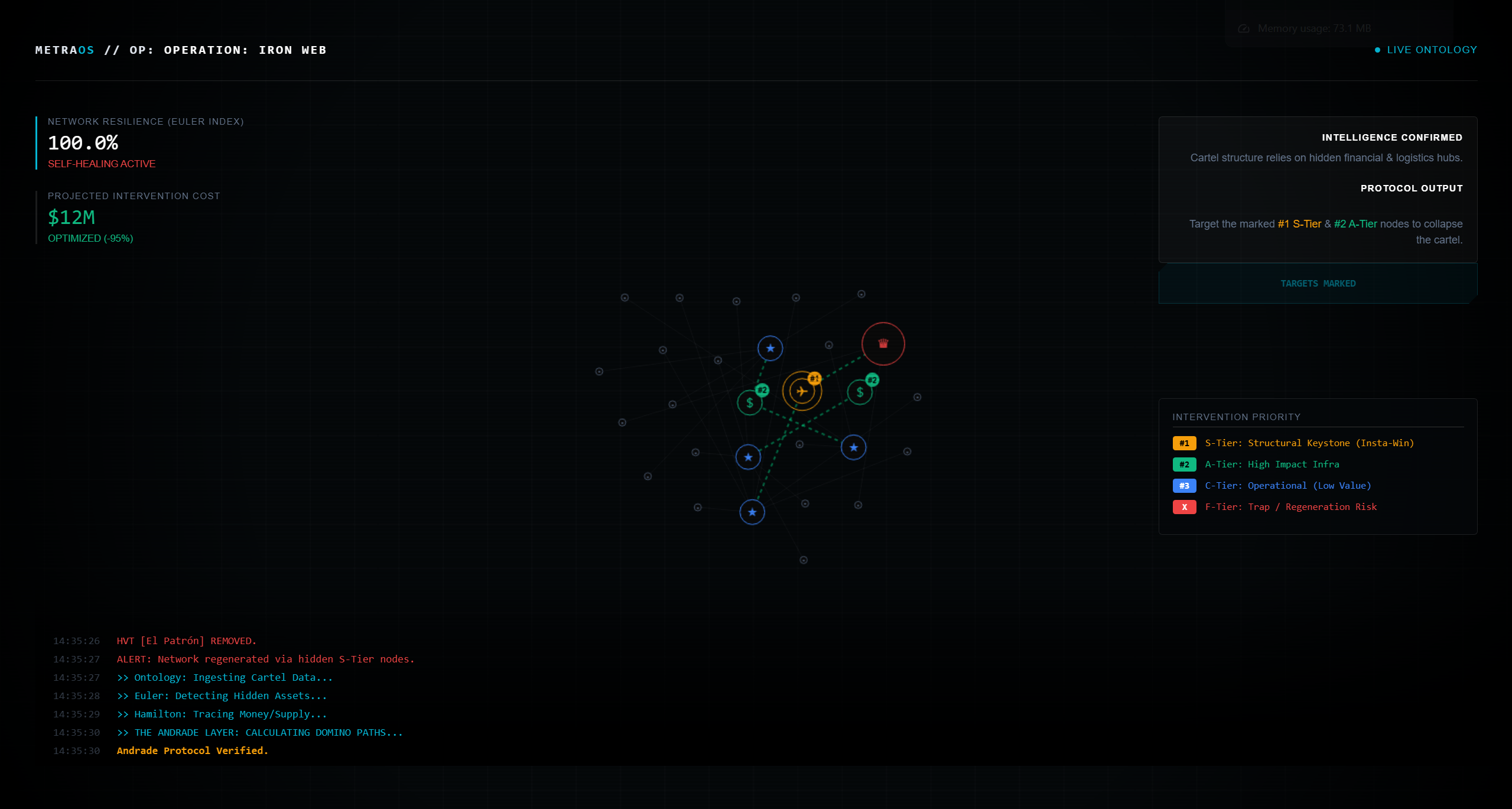
Applications
When complexity is structural, not statistical.
Government
- • Crisis prediction
- • Violence reduction
- • Urban planning
- • Public service bottlenecks
Enterprises
- • Supply-chain resilience
- • Logistics optimization
- • M&A synergy mapping
- • Customer risk & churn
Intelligence & Security
- • Criminal networks
- • Political risk
- • Terrorism structures
- • Illicit flows mapping
Why MetraOS
Traditional BI sees the past. AI sees patterns. MetraOS sees structure.
BI
Describes what happened. Cannot see hidden structure.
AI
Predicts patterns, but lacks causal understanding.
MetraOS
Reveals the architecture, simulates futures and identifies structural leverage.